When a Bargain Isn't Always a Bargain: The Aifos Auctions on the Costa del Sol
This month, a Costa del Sol property auction is making local headlines: Aifos — a Málaga-based development company currently in liquidation — is auctioning off a portfolio of garages and storage units across the region. The sale is being run through the Escrapalia Inmuebles platform, under the supervision of Málaga's Commercial Court No. 1.
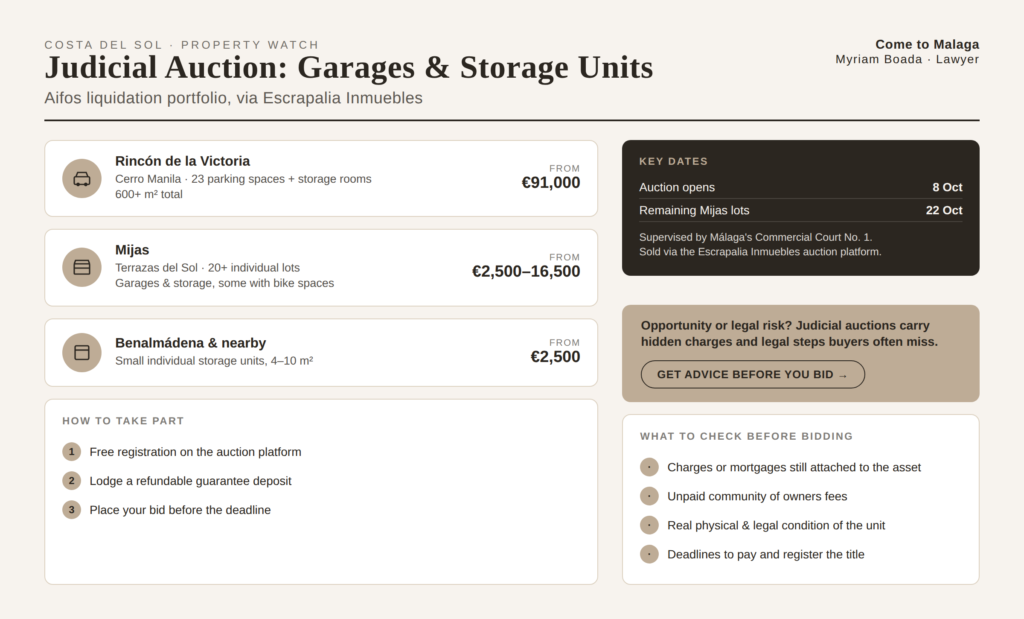
The numbers are eye-catching. In Rincón de la Victoria (Urbanización Cerro Manila), a single lot of 23 parking spaces — 13 of them with an attached storage room — plus two further storage units, spans more than 600 square metres and carries a starting price of €91,000. In Mijas (Terrazas del Sol), over 20 individual lots of garages and storage rooms are going for between €2,500 and €16,500, some bundled with bicycle spaces. In Benalmádena and other nearby developments, small storage units of 4-10 square metres are listed from €2,500. Bidding opens on 8 October, with the remaining Mijas lots following on 22 October.
Anyone interested can register for free on the platform and lodge a refundable deposit to take part.
For anyone who has ever dreamed of owning a little corner of the Costa del Sol at a fraction of market price, this kind of auction can look irresistible. It's also a good moment to talk about something I see far too rarely explained to international buyers: what actually happens, legally, when you buy property at auction in Spain.
Why a Costa del Sol Property Auction Works Differently
A court-supervised auction isn't like buying through an estate agent. There's no seller sitting across the table answering your questions, no negotiation on price, and often very limited opportunity to inspect the asset beforehand. Everything you need to know — the legal description of the property, any charges or debts attached to it, the terms of the deposit, the bidding increments, what happens if you're the winning bidder — is contained in the auction conditions and the property's Land Registry (Registro de la Propiedad) record. If you don't read those documents carefully, or can't read them at all because you're not based in Spain and don't speak Spanish, it's very easy to miss something important.
The most common risks I'd flag to a buyer considering this kind of purchase are: outstanding charges or mortgages that may not automatically disappear once you're awarded the asset; unpaid community of owners fees, which in Spain can in some cases pass to the new owner; the real physical and legal state of the unit, which you may not be able to inspect in person before bidding; and the practical steps needed after winning — from paying the balance within the deadline set by the court to registering the title in your name, which for a non-resident buying from abroad is rarely as simple as it sounds.
Where Legal Advice Earns Its Place
None of this means a Costa del Sol property auction is a bad idea — for the right asset, at the right price, with the right checks done in advance, it absolutely can be a smart move. But it's exactly the kind of purchase where having someone review the auction conditions and the registry situation before you bid, rather than after you've already won, makes all the difference. That's the part of my work I care about most: representing only the buyer's interests, checking what's really being sold before any money changes hands, and making sure that if you do go ahead, you understand precisely what you're signing up for.
If you've seen this auction — or any other property opportunity on the Costa del Sol — and want a second, independent opinion before you commit, I'm happy to help you look at it properly.
Myriam Boada Hernández, Lawyer — Come to Malaga